|
|
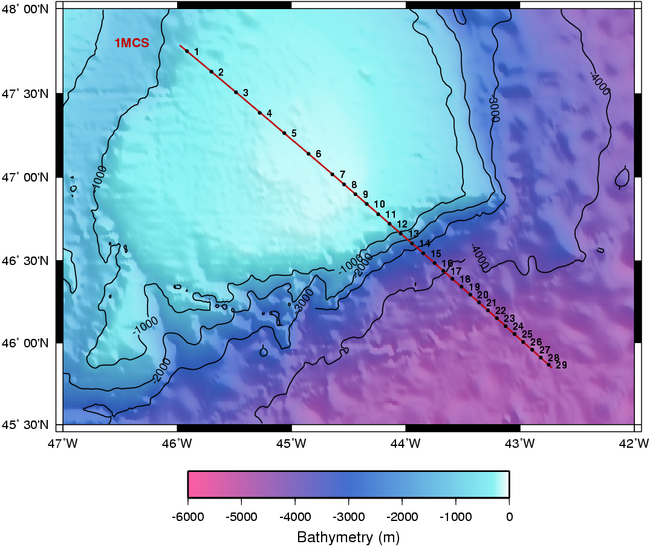
 Screech line 1MCS/1OBS
-
Abstract from:
Continental breakup and the onset of
ultraslow seafloor spreading off Flemish Cap on the Newfoundland rifted margin
Hopper, J.R., Funck, T., Tucholke, B.E., Larsen, H.C.,
Holbrook, W.S., Louden, K.E., Shillington, D., Lau, H., 2004. Geology, v. 32, no. 1, p. 93 - 96:
Continental breakup and the onset of ultraslow seafloor spreading off
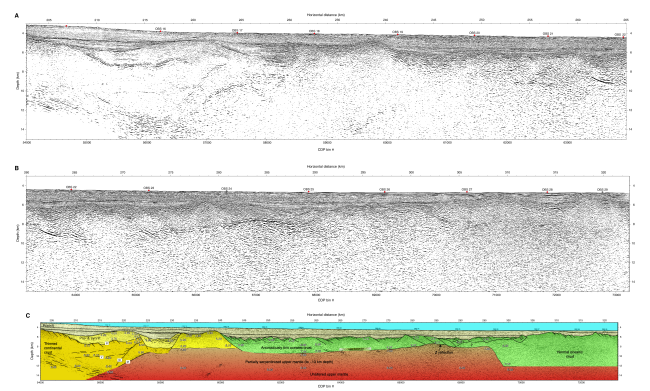
Flemish Cap on the Newfoundland margin show a structure of abruptly
thinning continental crust that leads into an oceanic accretion
system. Within continental crust, there is no clear evidence for
detachment surfaces analogous to the S reflection off the conjugate
Galicia Bank margin, demonstrating a first-order asymmetry in final
rift development. Anomalously thin (3 - 4 km), magmatically produced
oceanic crust abuts very thin continental crust very thin continental
crust and is highly tectonized. This indicates that initial accretion
of the oceanic crust was in a magma-limited
setting similar to present-day ultraslow spreading environments.
Seaward, oceanic crust thins to less than 1.3 km and exhibits an unusual, highly
reflective layering. We propose that a period of magma starvation
led to exhumation of mantle in an oceanic core complex that was
subsequently buried by deep-marine sheet flows to form this layering.
Subsequent seafloor spreading formed normal, ~6 km thick oceanic crust.
This interpretation implies large fluctuations in the available melt
supply during the early stages of seafloor spreading before a more
typical slow-spreading system was established.
- Abstract from:
Crustal structure of the ocean-continent transition at Flemish
Cap: Seismic refraction results
Funck, T., Hopper, J.R., Larsen, H.C., Louden, K.E., Tucholke, B.E., Holbrook,
W.S., 2003. Journal of Geophysical Research, Vol. 108, No. B11, 2531,
doi:10.1029/2003JB002434:
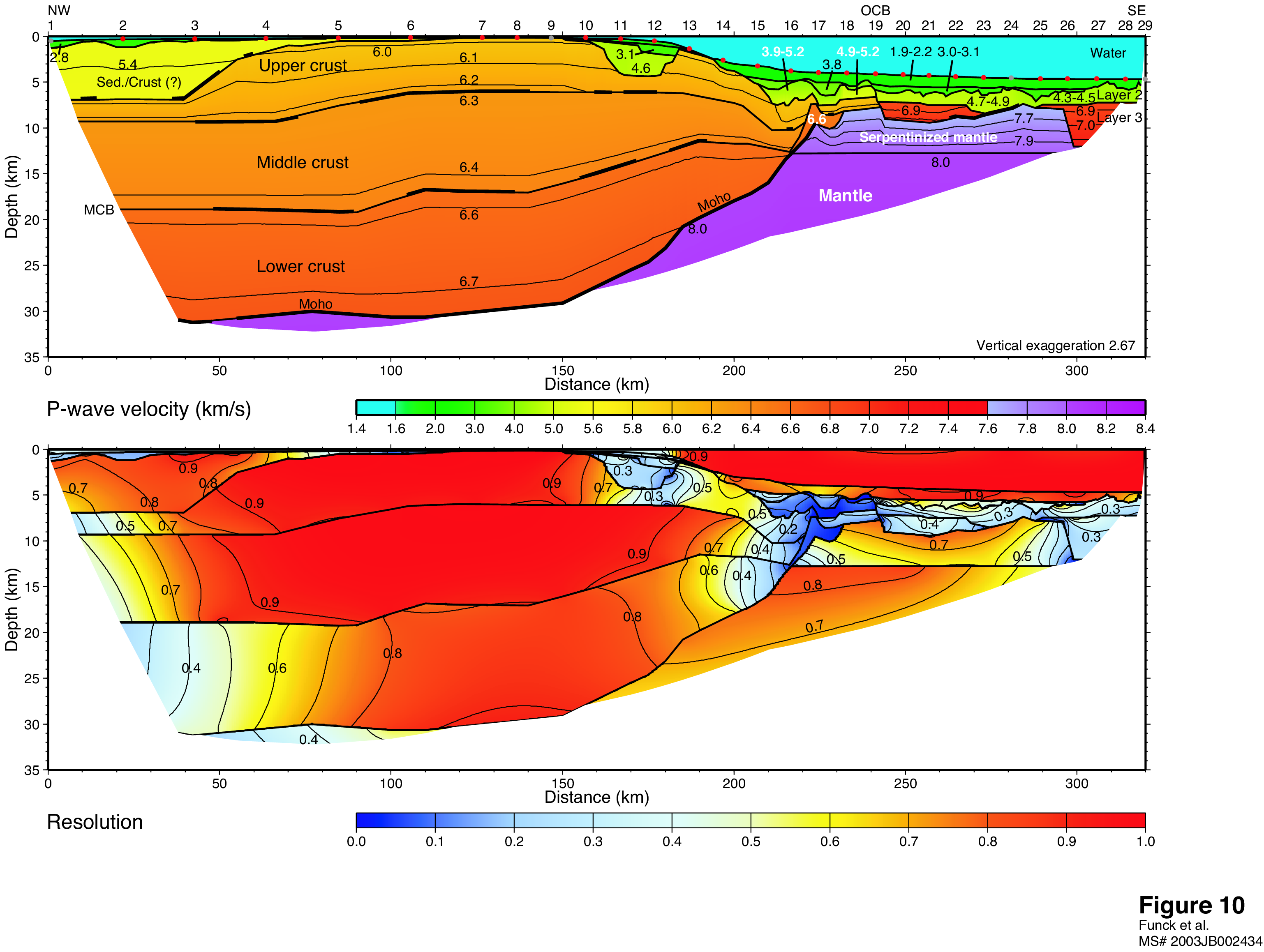
We conducted a seismic refraction experiment across Flemish Cap and into
the deep basin east of Newfoundland, Canada, and developed a velocity
model for the crust and mantle from forward and inverse modeling of data
from 25 ocean bottom seismometers and dense air gun shots. The
continental crust at Flemish Cap is 30 km thick and is divided into
three layers with P wave velocities of 6.0-6.7 km/s. Across the southeast
Flemish Cap margin, the continental crust thins over a 90-km-wide zone to
only 1.2 km. The ocean-continent boundary is near the base of Flemish Cap
and is marked by a fault between thinned continental crust and 3-km-thick
crust with velocities of 4.7-7.0 km/s interpreted as crust from magma-starved
oceanic accretion. This thin crust continues seaward for 55 km and thins
locally to ~1.5 km. Below a sediment cover (1.9-3.1 km/s), oceanic layer
2 (4.7-4.9 km/s) is ~1.5 km thick, while layer 3 (6.9 km/s) seems to
disappear in the thinnest segment of the oceanic crust. At the seawardmost
end of the line the crust thickens to ~6 km. Mantle with velocities of
7.6-8.0 km/s underlies both the thin continental and thin oceanic crust in
an 80-km-wide zone. A gradual downward increase to normal mantle velocities
is interpreted to reflect decreasing degree of serpentinization with depth.
Normal mantle velocities of 8.0 km/s are observed ~6 km below basement.
There are major differences compared to the conjugate Galicia Bank margin,
which has a wide zone of extended continental crust, more faulting, and
prominent detachment faults. Crust formed by seafloor spreading appears
symmetric, however, with 30-km-wide zones of oceanic crust accreted on both
margins beginning about 4.5 m.y. before formation of magnetic anomaly M0 (
~118 Ma).
Multichannel Reflection Seismic Line 1MCS
- Click for pdf version (1.9 MB) of mcs line and interpretation.
Velocity Model and Model Resolution
|
|